

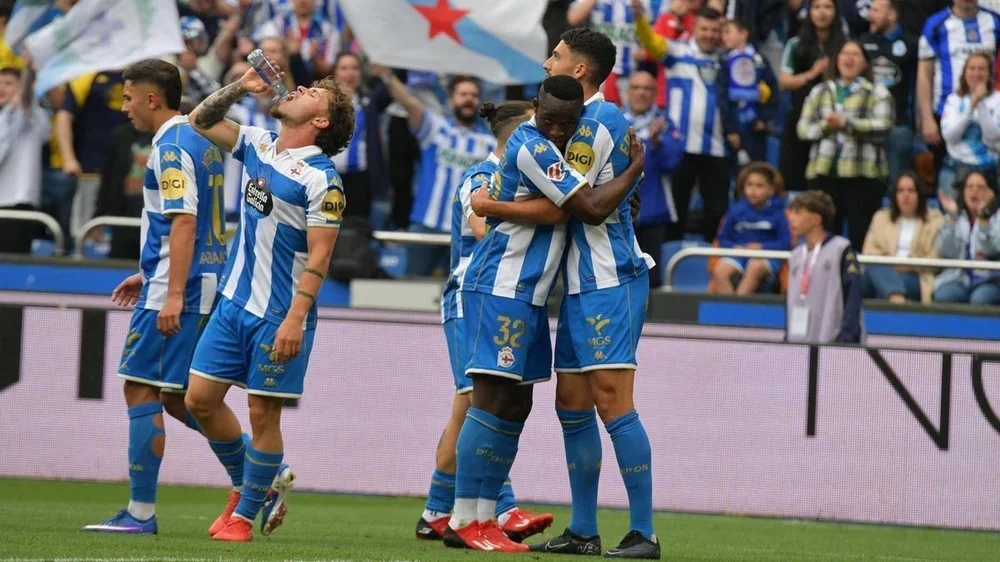
Eddahchouri and Bil embrace after the Dutchman’s goal against Mirandés.
As the season reaches its decisive stretch, Deportivo La Coruña controls its own destiny. The reality is tangible, clear, and full of promise. While Antonio Hidalgo’s squad prepares to host Andorra next Sunday, fans have already begun adorning balconies with flags and scarves, eagerly awaiting the penultimate round of the Segunda División.
Calculations are unavoidable—on the streets, at work, in the gym, in bars. There is no other topic of conversation in A Coruña. And history is on their side. Over the last 15 seasons, under the current promotion system to La Liga—two direct spots and one via playoffs—27 of the 30 teams that reached this stage among the top two maintained their privileged positions. Almería, level on points with the blue-and-whites, will try to defy the statistics; they have already fallen short once under this format.
A ten-game unbeaten run, with six wins and four draws, has placed the Galician side in an enviable position with three matches left. Deportivo is exactly where it would have signed up for at the start of the campaign: fighting for promotion to La Liga and depending only on itself. Up next are Andorra, Valladolid, and Las Palmas—tests of the team’s maturity and resilience. Everyone desires it, everyone wants it more than anything, but only Racing Santander and Deportivo control their fate on the pitch. At this stage, that speaks volumes.
In the 2010-11 season, the Segunda División introduced its current format: two direct promotions and one through the playoffs. The competition gained excitement, parity, and an extra month of action—agony for participants, delight for spectators. Deportivo’s only previous experience in the playoffs ended in bitter disappointment. According to recent history, the club must secure promotion directly.
And it is history—and statistics—that now favor the Deporistas. In that 2010-11 campaign, Real Betis and Rayo Vallecano reached matchday 39 with 76 and 73 points respectively. The Madrid side, in second place, held a nine-point cushion over Elche. They finished with an eight-point gap over Barcelona B and ten over Elche, cementing their promotion. Since then, it has been almost a constant: 27 of the 30 teams occupying the top two positions at this stage have gone on to be promoted. The only exceptions among second-place teams are Girona in 2014-15, and Eibar in 2021-22 and 2022-23. In Girona’s case, they took seven of the last nine points but finished level on 82 with Sporting Gijón, who won on head-to-head. Currently, Deportivo holds the head-to-head advantage over Almería. Years later, Eibar went from 74 points (a two-point lead) to 80, missing out by one point to Almería and Valladolid, both on 81. The following season was even crueler: from 67 to 72 points, losing out on head-to-head against Las Palmas.
Two precedents when second and third were level on points occurred in the early years of the format. In 2011-12, Celta had 78 points, same as Real Valladolid. The Celestes finished with 85 and secured promotion after a three-way race won precisely by Deportivo, who closed the campaign with a historic record of 91 points under José Luis Oltra. A season later, Villarreal faced the same situation, tied on points with Almería. The Andalusian side had already experienced this, and it ended with elation for the Yellow Submarine, who took nine points from nine.